
Pillars of Creation
Most—if not all—of my inspiration as of the last couple of years is exclusively space-themed and drawn from photos released from the James Webb Space and Hubble Telescopes or the Voyager, Cassini, and Juno missions. However, my quilt Pillars of Creation did not come across my radar as a design until after I received a text of the Eagle Nebula’s famous photo of the same name from my friend, Ian (@offkiltercrafterian).
We were having a casual conversation over our shared interest in the stars and shared which photos were our favorites. When he shared his, I was in awe. I knew of the Pillars of Creation photo, as taken by Hubble originally in 1995, but I hadn’t seen the version he had shared before, a composite of the two telescopes. It had so much vibrance and color defining the background and foreground. It also made me ponder the natural formations on our very own planet.
I started to sketch out hexagonal pillars on graph paper, designed with depth in mind so the experience would feel similar in expanse as the nebulous structure itself. The idea to use hexagonal-shaped pillars came from the natural rock form Giant’s Causeway in Ireland. It’s an unusual and awesome shoreline of rock structures with irregular hexagon shapes. There are a lot of myths around how they formed, but I found it to be a nice way to tie in an earthly element to something inspired light-years from us.
To further emphasize the foreground and background, I alternated the direction of the half-square triangles (HSTs) directions. The background received HSTs descending in seam direction from left to right, while the foreground HSTs went in the opposite direction. This also supported the direction of the pillars.
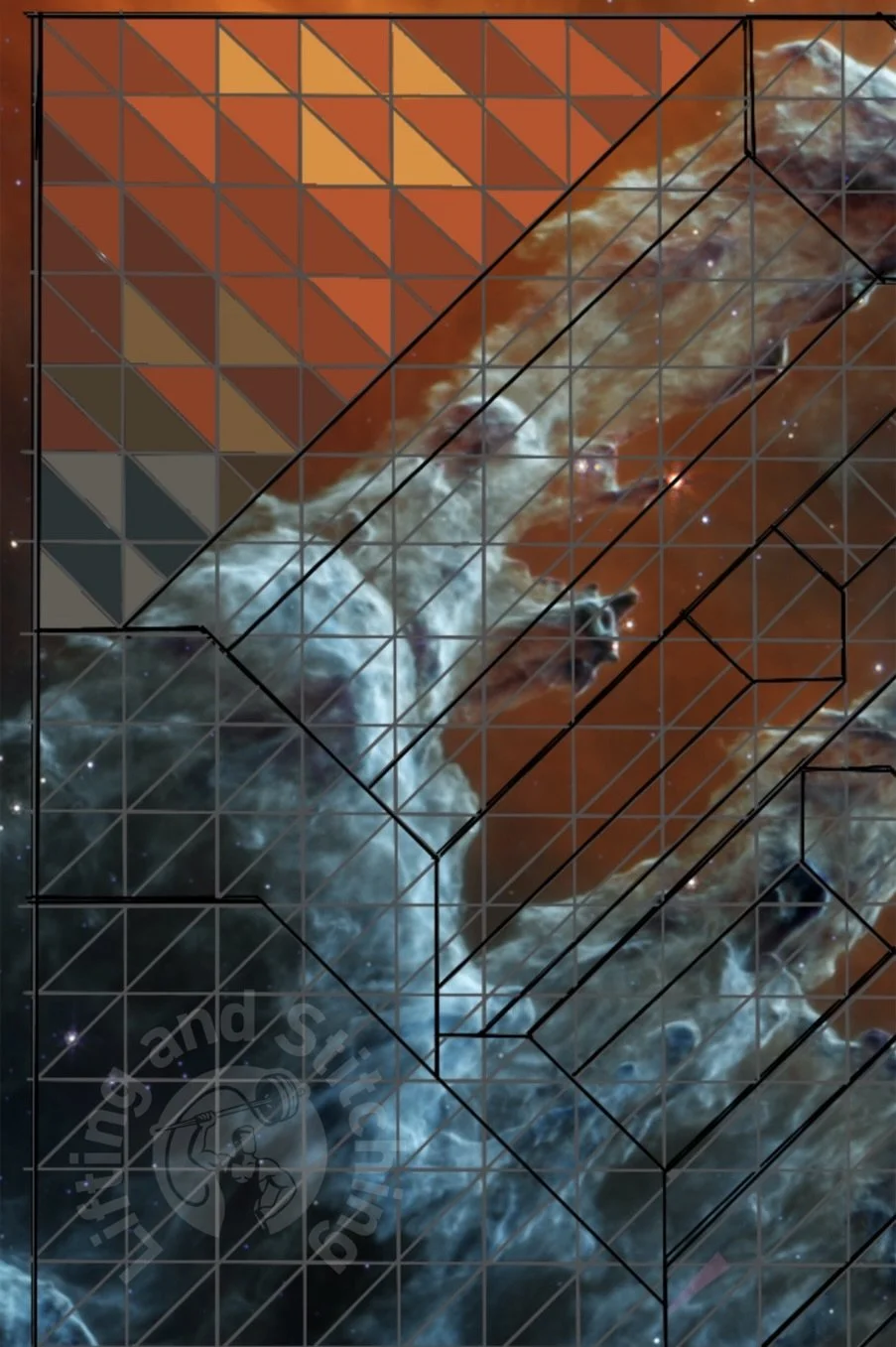
Digital sketch of the pillars and HSTs over the photo inspiration. I posted a timelapse video on my Instagram of the full process sketching the design.
The colors were easy to choose: they had to be a combination of grays, browns, reds, oranges, and blues. The pillars received more of the cooler colors, while the background received more of the warmer colors.
I ended up designing foundation paper templates for each of the 192 blocks (some were repeats). This was essentially about staying organized. When it comes to a large-scale project, it’s not uncommon that I get a bit turned around. It was also important for ensuring the colors never got out of order, especially with some of the shades being so close in color.
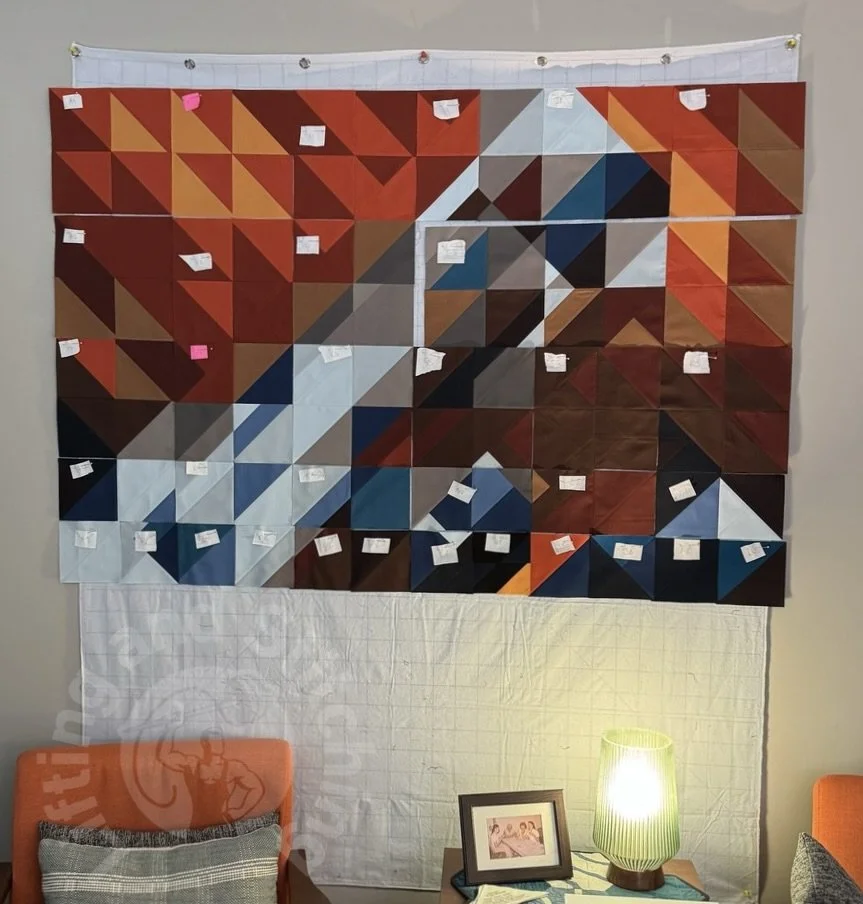
Progress photo showing the first half of the quilt coming together. Labels kept me organized against the grid plan.
The quilt was fun to sketch and design, but executing the quilt was another situation altogether. I got to a point where I felt a bit irritated or bored. That’s an awful feeling to have. I can’t explain why that feeling came over. I suspect it had a lot to do with how long it was taking. I also started to feel a lot of imposter syndrome around it, thinking it wasn’t good enough. It wasn’t until toward the end of the project that I started to really enjoy it again—especially when I saw the left side of the quilt fully coming together. I loved the warm to cold, the opposing directions. Seeing the colors arranged gave me the inspiration to bind the quilt with select fabric from the top to further honor the colors.
Quilting was a natural choice. Once again, I collaborated with my celestial sister, Lacie Messerly of Messy Quilts, to do a diagonal cross-hatch all-over quilting design to interplay with the HSTs in the design. She used a dark gray thread, my usual choice color, for the quilting. The backing of the quilt was a fun—and surprising—choice. Usually, I select Speckled by Rashida Coleman-Hale for Ruby Star Society because it often feels like a starry scene. However, we found a fabric (51710D-X) with some of the colors in the collection Horizon by Grant Haffner for Windham Fabrics.
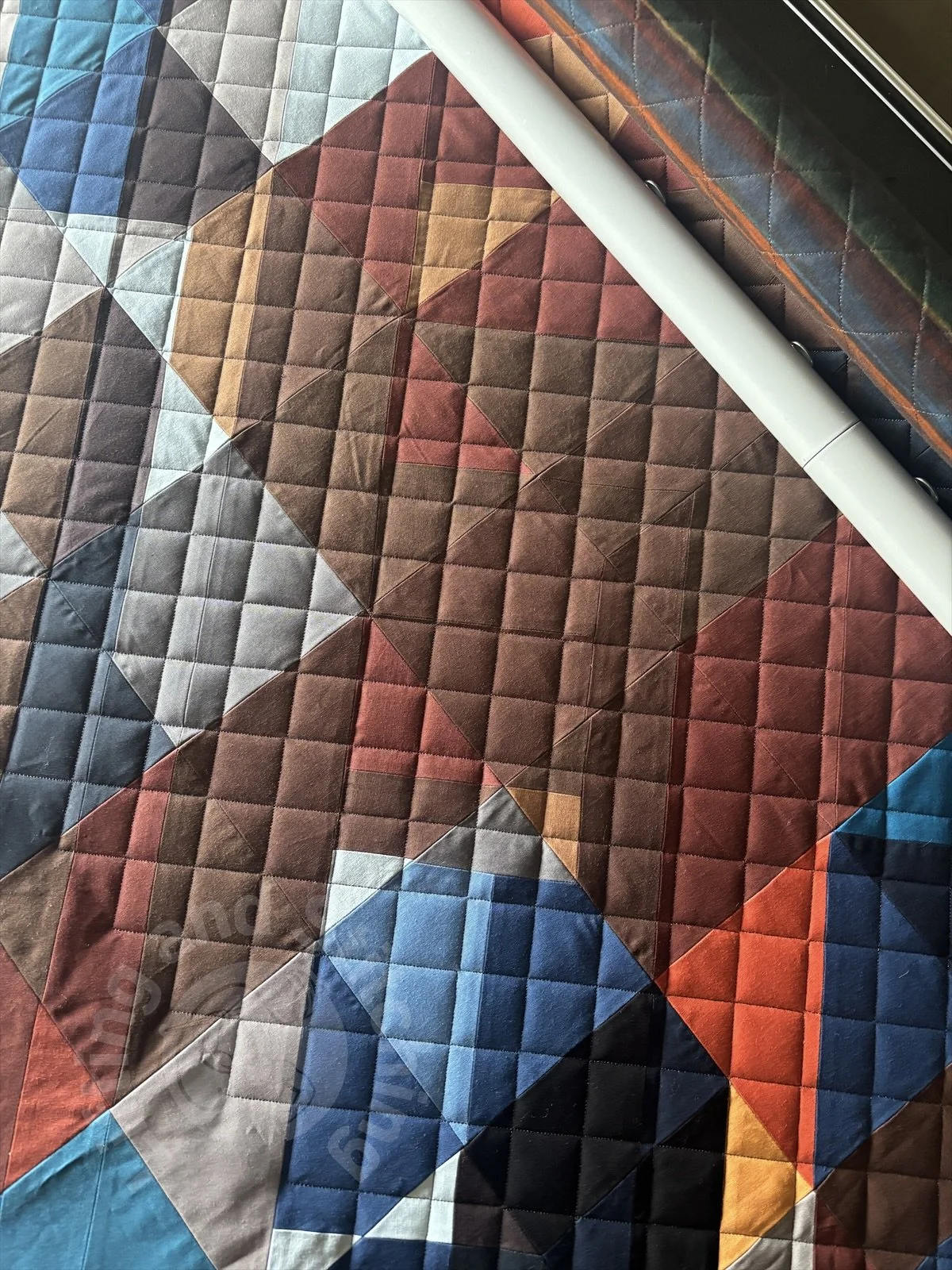
A cross hatch was diagonally quilted to support the directional design of the piecing by longarm.
I finished the quilt on October 12, 2025, and love it! I’m so happy with the pictorial impact of the nebula, and I give so much credit to my friend, Ian, for providing that spark of inspiration to make a quilt based on the famous structure.
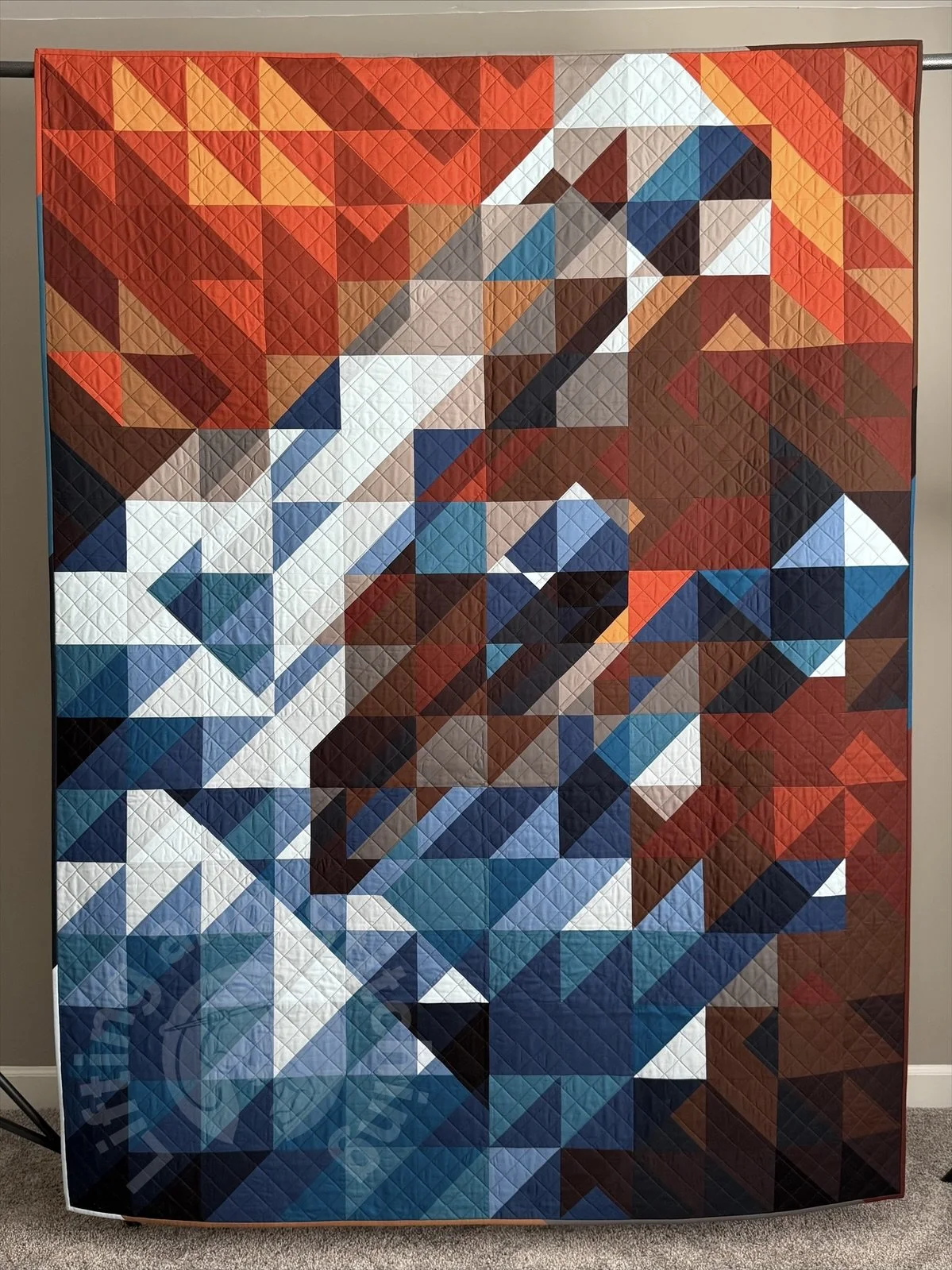
Finished quilt photograph! Pillars of Creation by Joshua Dunn, 2025, measuring at 60” wide by 80” tall.